


3 November 2026
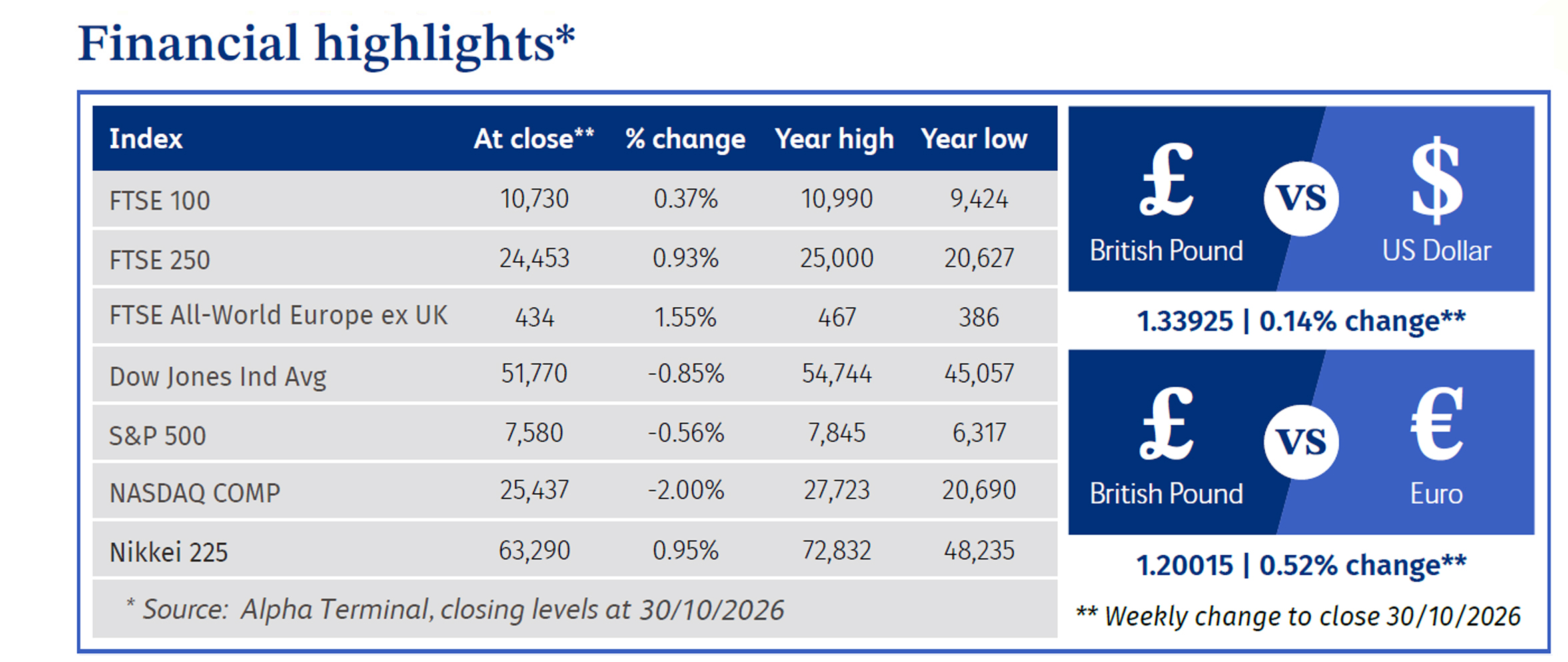
Chancellor John Healey's first Budget last Wednesday raised taxes while keeping the planned current budget surplus by 2030, and it did not trigger the gilt market sell-off some investors had feared, with the 10-year UK gilt yield easing to 5.28% from 5.36%. The bank corporation tax surcharge was temporarily doubled to 6%, and £20.4 billion was committed to the National Wealth Fund and the British Business Bank. Gas standing charges are to be scrapped for around 23 million households from 2027. Data released in Nationwide’s latest House Price Index showed annual house price growth slowing to 0.5% for the year to October from 0.8% in September, which the mortgage lender attributed to higher energy prices and mortgage costs.
Oil set the tone for the UK market, with Brent Crude easing to $112 a barrel from $116 a week earlier after European Union states reaffirmed the release of 42.6 million barrels from strategic reserves and US contact with Iran revived hopes of talks, though attacks around the Strait of Hormuz kept risk premium elevated. Energy companies were resilient despite the softer price, on strong refining margins, with Shell's indicative margin reaching $42 a barrel in the third quarter from $24. Banks drew support from growing net interest income, and a Budget tax surcharge increase of 6% (effective 01/01/2027 to 31/03/2028), smaller than the 8% figure speculated. The FTSE 100 and FTSE 250 both ended the week higher.
The US Federal Reserve left the federal funds rate unchanged at 3.75% to 4% and upgraded its description of growth to “strong” from “solid.” Gross Domestic Product ("GDP") expanded at an annualised 3.4% in the third quarter from 2.2% in the second. Inflation stayed firm, with the Personal Consumption Expenditures ("PCE") price index up 3.6% for the year to September and Core PCE, which excludes food and energy, up 3.1%, both higher than in August. Strong growth and firm inflation point the same way for policy, yet equities fell as results from technology companies Alphabet and Amazon renewed concern about returns on artificial intelligence ("AI") spending. The 10-year Treasury yield eased to 4.93% from 5% and the 2-year Treasury yield to 4.59% from 4.65%.
The European Central Bank left its Main Refinancing Operations interest rate at 2.65% and its Deposit Facility Rate at 2.5%, having discussed an increase but choosing unanimously to hold. Eurozone GDP grew 0.4% in the third quarter against expectations of 0.2%, while France contracted 0.1% on weaker investment and exports. French inflation reached 3.4% for the year to October from 3.1% in September, and Italy's rose to 5.4% from 4.2% in September. European equities rose on strong energy results, though banks were mixed on softer net interest income and carmakers faced Chinese competition. The 10-year German Bund yield edged down to 3.32% from 3.55% in September.
The Bank of Japan held its policy rate at around 1.25% and judged underlying inflation consistent with its 2% target, while more than doubling the pace of its exchange traded fund sales from January 2027. The Tokyo core Consumer Price Index, which excludes fresh food, rose 2.6% for the year to October from 2.7% in September. Japanese equities were lifted by optimism on AI through midweek before a sharp Friday sell-off. In China, the Fifth Plenum meeting of the ruling party’s Central Committee closed without new stimulus, while industrial profits rose 14.4% for the year to September from 4.2% in August.
Babcock International is a British defence contractor providing support for naval and nuclear operations. Over the past week, the company’s shares climbed 9.03% to close at £10.24 on Friday. This solid performance was primarily driven by the Autumn Budget confirming a defence spending target of 3% of GDP by 2030. The move showcased renewed investor confidence. The stock's upward momentum was further supported by management's ongoing £200 million share buyback programme ahead of their half-year earnings release coming on 19th November.
AstraZeneca is a British pharmaceutical company providing treatments for oncology and rare diseases. Over the past week, the company climbed 8.86% to close at £139.60 per share on Friday. This solid performance was primarily driven by strong third quarter earnings with profits of $2.79 per share. The company’s performance was galvanised by management reaffirming its full-year revenue guidance following a robust 7% rise in total quarterly revenues, reaching $16.21 billion overall.
Haleon is a British consumer healthcare company. Over the past week, the company’s shares plunged 16.2% to close at 319.4p on Friday. This weak performance was primarily driven by a poor third quarter earnings miss with revenues of just 2.6% growth. The stock was also hurt by management downgrading its full-year revenue guidance after a sluggish third quarter with yearly targets reaching a total of 2.5% growth.

Market Commentary prepared by Walker Crips Investment Management Limited.
This publication is intended to be Walker Crips Investment Management's own commentary on markets. It is not investment research and should not be construed as an offer or solicitation to buy, sell or trade in any of the investments, sectors or asset classes mentioned. The value of any investment and the income arising from it is not guaranteed and can fall as well as rise, so that you may not get back the amount you originally invested. Past performance is not a reliable indicator of future results. Movements in exchange rates can have an adverse effect on the value, price or income of any non-sterling denominated investment. Nothing in this document constitutes advice to undertake a transaction, and if you require professional advice you should contact your financial adviser or your usual contact at Walker Crips. Walker Crips Investment Management Limited is authorised and regulated by the Financial Conduct Authority (FRN:226344) and is a member of the London Stock Exchange. Registered office: 128 Queen Victoria Street, London, EC4V 4BJ. Registered in England and Wales number 4774117.



Important Note
No news or research content is a recommendation to deal. It is important to remember that the value of investments and the income from them can go down as well as up, so you could get back less than you invest. If you have any doubts about the suitability of any investment for your circumstances, you should contact your financial advisor.

The value of investments can fall as well as rise. Investors may get back less than invested. Past performance is not a reliable indicator of future results.
The value of investments can fall as well as rise. Investors may get back less than invested.


