

2 April 2026
Artificial intelligence (“AI”) has undoubtedly been valuable to individuals and organisations, especially when they are seeking answers quickly. By using large data sets and asking specific questions, the software can quickly root out the required information.
The adoption of AI in the UK has been prolific since most individuals have constant access to their smartphones, and many apps have integrated AI into their programming.
By some estimates, 76% of UK internet users reported using AI in January 2026, with 24 million people using ChatGPT monthly (Source: IAB UK).
Within the investment management sector, many investors are now asking themselves, “Is AI a passing investment fad?” and, “How will AI impact investment managers?”
Regarding the first question, looking at the fundamentals, there has been a lot of revenue growth within AI-related stocks, but at this early stage, profits have been fairly elusive. At the moment, a core group of large global companies are staking huge sums of shareholder capital to ensure that, when AI profits arrive, they will benefit.
Many ‘Magnificent 7’ companies (the collective name for Alphabet (Google), Amazon, Apple, Meta Platforms (Facebook), Microsoft, Nvidia, and Tesla) will generate some strong free cash flow from AI. Much of this capital will be re-invested into highly expensive AI chips and data centres to continue growing the sector. In addition, quite a few of the top companies have equity stakes in each other’s partners, such as OpenAI and Anthropic. With the result that demand is partially self-created within this ‘close-knit’ group. The concern is that if one large AI-related name were to fail it could cause a drop in the share price of others.
Whilst AI has proven its ability to quickly spot significant patterns in data, profits have been hard to come by. This is quite possibly because we are in the very early stages of AI adoption by both individuals and corporations. Part of the challenge will be how AI-related software can be quickly incorporated within workflows to make customer experiences and industrial processes run more smoothly.
So the jury is still out on the first question.
Now, regarding the second question, AI can carry out large volumes of repetitive tasks more quickly than a human, which could help investors generate a short list of companies to invest in rather than having to rely on the expertise of investment managers.
However, AI lacks one key ingredient for good, quality financial management: personal advice for your unique situation. An investment manager can look at your financial situation holistically and come to a workable solution and advise you on the next steps going forward. AI can only give you a list of options from the information you have provided.
Investment managers can also offer ‘face-to-face’ advice and a more personal touch when discussing the most emotive of subjects, money. These types of questions typically include highly sensitive topics for the individual, such as “Will I have enough income to fund my forthcoming retirement?”
Equally, when faced with larger and complex tax-related issues, investors still seem to favour one-to-one advice from a trusted human adviser!
There is absolutely still the need for in-person investment managers. However, managers can use AI to enhance the service they provide to clients. For example, it can filter out a lot of the noise during the data collection phases, but it cannot replace that human touch.
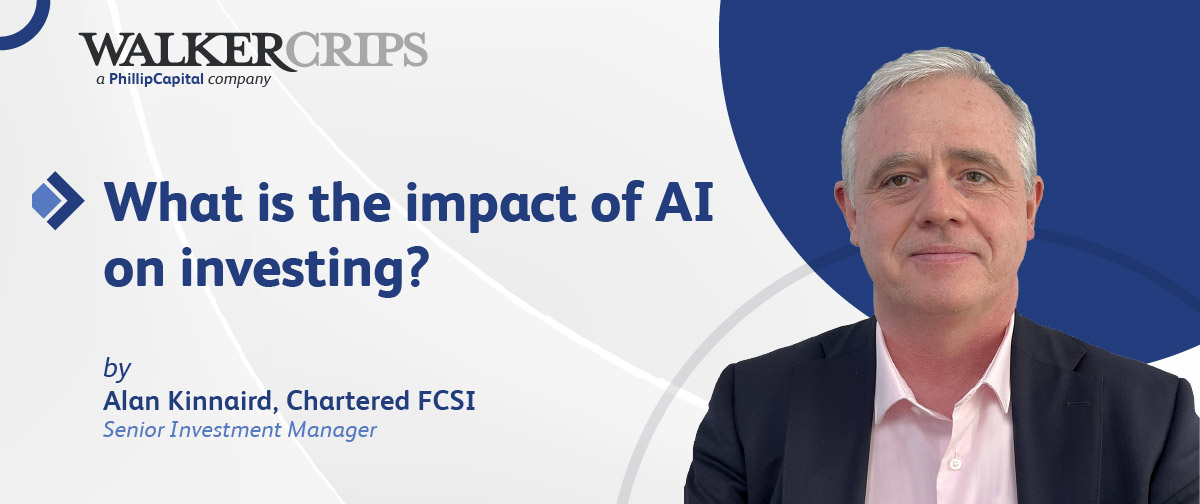
Alan Kinnaird Chartered FCSI
Senior Investment Manager
Alan Kinnaird manages portfolios for private individuals, charities and trusts. He is primarily based in our York office. To contact Alan for a free initial review of your investments please call him on 020 3100 8130 or email alan.kinnaird@wcgplc.co.uk.
Important information
This article is intended to be Walker Crips Investment Management's own commentary on markets. It is not investment research and should not be construed as an offer or solicitation to buy, sell or trade in any of the investments, sectors or asset classes mentioned. The value of any investment and the income arising from it is not guaranteed and can fall as well as rise, so that you may not get back the amount you originally invested. Past performance is not a reliable indicator of future results. Movements in exchange rates can have an adverse effect on the value, price or income of any non-sterling denominated investment. Nothing in this document constitutes advice to undertake a transaction, and if you require professional advice you should contact your financial adviser or your usual contact at Walker Crips. Walker Crips Investment Management Limited is authorised and regulated by the Financial Conduct Authority (FRN:226344) and is a member of the London Stock Exchange. Registered office: 128 Queen Victoria Street, London, EC4V 4BJ. Registered in England and Wales number 4774117.

.jpg "Market Commentary Podcast: Deep dive on Structured products")


Important Note
No news or research content is a recommendation to deal. It is important to remember that the value of investments and the income from them can go down as well as up, so you could get back less than you invest. If you have any doubts about the suitability of any investment for your circumstances, you should contact your financial advisor.

The value of investments can fall as well as rise. Investors may get back less than invested. Past performance is not a reliable indicator of future results.
The value of investments can fall as well as rise. Investors may get back less than invested.


